Subject: warrior
Culture: Single Grave / late Corded Ware culture
Setting: Dagger Period, Scandinavia 1800-1500BC
Evolution:
Context (Event Photos, Primary Sources, Secondary Sources, Field Notes)
* Carnegie Museum of Natural History
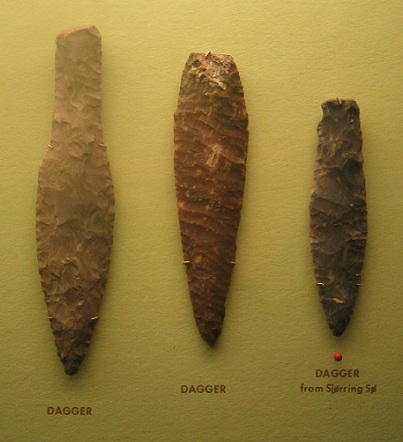
"DAGGER PERIOD The influence of metal-working peoples in other parts of Europe began having an effect on the Single Grave people of Denmark about 1800 B.C. Changes in culture are reflected in the fact that the typical artifacts of 1800 to about 1500 B.C. were long, slim, beautiful daggers and spear-heads copied after metal weapons but made of flint."
Dagger
* Capwell 2011 p12
"The earliest examples from the Dagger Period have long, narrow blades and are roughly diamond-shaped in profile. One half of the diamond functioned as the grip or handle but was not as finely worked as the other end, the blade, which had precise pressure-flaked edges and a passable point. The handle end on later examples gradually loses its taper, becoming more straight-sided, while the cross-section is rounder for a more comfortable grip. Finally, the butt of the handle becomes flared to improve the grip even further. The fully-fledged dagger of this period, in addition to the well-formed grip and butt, generally displays a graceful, leaf-shaped blade that has been cunningly strengthened by broadening and thickening only where necessary."
* Peterson/Feaser 1966 p15-16
"Perhaps the finest of all stone knives ... were made in Scandinavia, particularly in Denmark. In these northern lands wonderful materials were available. Flint was plentiful and ranged in color from a light yellowish tint through amber to a dark brown, almost black. Quartzite could be obtained in black, green, red and white. No other area in the world offered a wider variety of fine stone, and ancient craftsmen too full advantage of their good fortune. They developed graceful forms. Long flat diamond shapes were followed by leaf-shaped blades with cylindrical handles made in one piece, and finally by broad-bladed daggers boasting rounded grips and flaring pommels at the butt end. The Stone Age lasted longer in Scandinavia than in the rest of Europe, and these late daggers are believed to be copies of bronze types already in use in countries further south. So common did these beautiful stone knives become that archaeologists call the years from 1800 to 1500 B.C. the Dagger Period. Even after the Bronze Age came to Scandinavia, skilled workers continued to make stone knives because metal was a scarce, expensive resource. Copying the design of metal knives from other areas, they sometimes fabricated almost unbelievably difficult shapes in stone. Eventually, bronze knives became cheap enough for everyone to afford, and the techniques of flaking and polishing stone died out."